
Gaetano Lo Presti's new book puts AI at the heart of Contemporary Marketing
The founder of Contemporary Marketing releases Artificial Intelligence in Contemporary Marketing worldwide. His argument: AI should sharpen human judgement, not replace it.
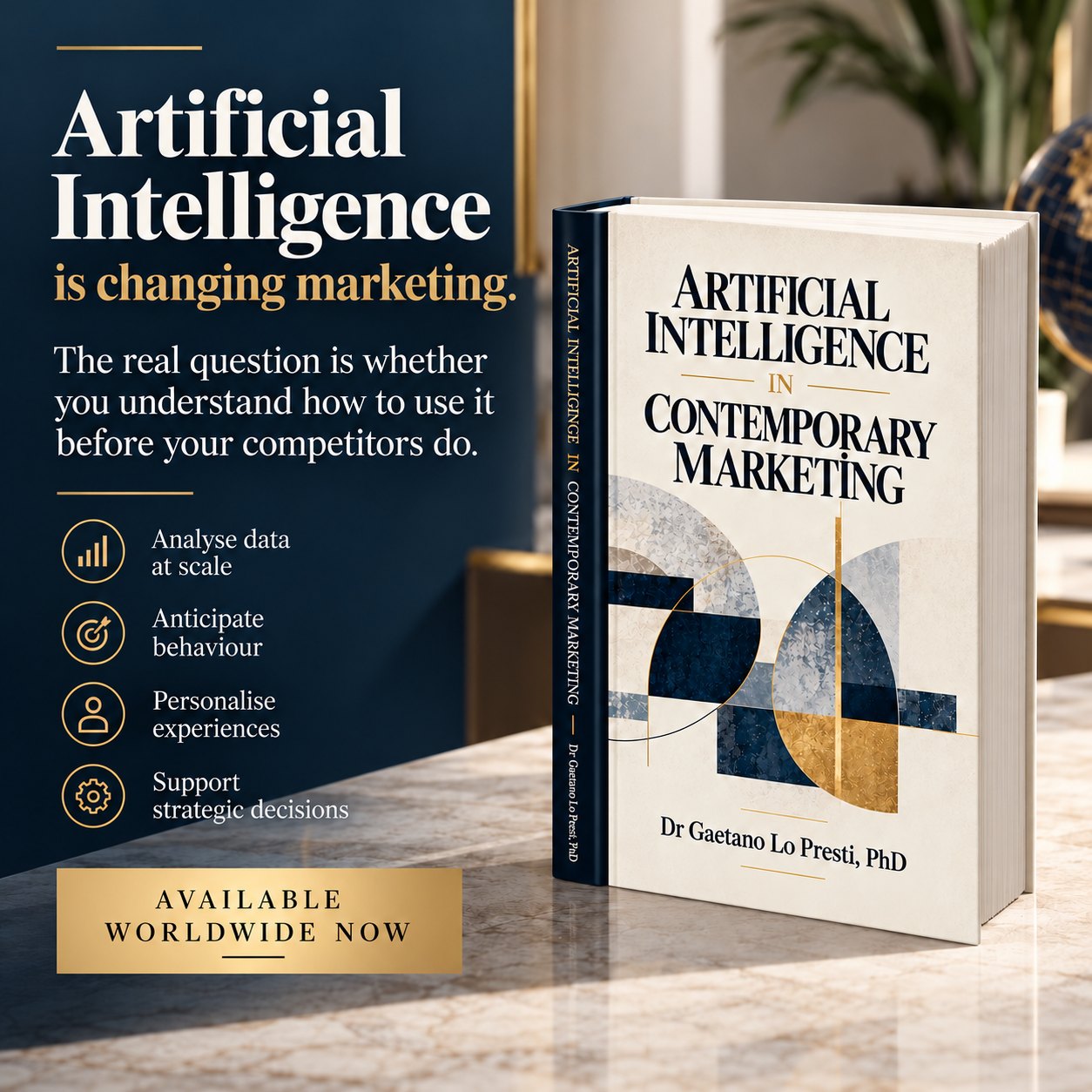
The economist and strategist Dr Gaetano Lo Presti, PhD, founder of Contemporary Marketing, today publishes his new book Artificial Intelligence in Contemporary Marketing worldwide. The release on Thursday, 22 October, comes at a moment when companies in Switzerland and abroad are investing heavily in artificial intelligence – often without a clear idea of what the technology should actually achieve for them.
The book follows Contemporary Marketing: AI, Data Analysis, Neuroscience, which became an Amazon UK bestseller. Where the earlier work set out the method as a whole, the new title concentrates on one of its three pillars: artificial intelligence. Its starting point is deliberately sober. Having access to AI, Lo Presti argues, is not the same as knowing how to use it strategically.
A method built on three pillars
Contemporary Marketing, the approach Lo Presti developed and for which he is known as its father, treats marketing as a measurable discipline rather than a matter of opinion. It combines artificial intelligence, data analysis and neuroscience to understand how markets and consumers really behave, and to anticipate their reactions before a budget is committed.
Lo Presti holds a PhD in marketing, an MBA, an MSc in marketing, a BSc in economics and a BA (Hons) in international studies. He leads the consultancy Lo Presti – Business & Marketing Strategies and the Lo Presti Institute of Research, Technology and Innovation.
His work reaches deep into Switzerland. Lo Presti is a consultant to major Swiss companies and to government agencies, advising them on strategy, data and the use of artificial intelligence. During the COVID-19 pandemic he served as a strategic consultant to governments and pharmaceutical companies on vaccination campaigns, working on one of the hardest communication problems of the period: countering misinformation and the arguments of vaccine opponents.
Why data alone is not intelligence
The book raises questions many executives will recognise. Why can an organisation hold vast amounts of customer data and still misread its market? Why is automation not automatically artificial intelligence? How does a company move from reporting what happened yesterday to anticipating what may happen tomorrow? And where should AI make decisions, and where must human judgement stay in control?

To answer them, Lo Presti moves from the underlying technologies – machine learning, natural language processing, generative AI and computer vision – to their concrete use in marketing: market research and consumer intelligence, predictive analytics, personalisation, customer experience, content creation, recommendation systems, campaign management and the measurement of marketing performance. The book is explicitly not a collection of tools, prompts or short-lived trends. Its real subject is intelligence.
Human judgement stays in charge
One principle runs through every chapter: artificial intelligence should strengthen human intelligence, not replace it. Algorithms can analyse, models can predict and machines can generate. None of them, however, can decide what an organisation should stand for, which relationships it must protect or which ethical lines it must not cross. In Lo Presti's view, that responsibility remains human.
The author therefore gives considerable space to the risks that grow as AI becomes more capable: privacy, bias and discrimination, transparency, intellectual property, synthetic deception, accountability and the governance of responsible AI.
A timely subject for Swiss companies
For Switzerland the topic is anything but abstract. Swiss firms, from large exporters to small and medium-sized businesses, are using AI in customer service, sales and communication. They do so under the revised Federal Act on Data Protection, in force since September 2023, and increasingly under the European Union's AI Act whenever they sell into the EU. Transparency, data quality and accountability – themes the book treats in detail – are therefore everyday concerns for marketing departments in Zurich, Geneva, Basel and Lugano.
The book speaks to several audiences. Marketers are invited to move beyond intuition, entrepreneurs to recognise opportunities hidden in their own information, and executives to understand what AI can genuinely deliver before investing in systems that promise more than they provide. For students and researchers, it offers a framework for studying how artificial intelligence is transforming the discipline.
What the release means
With Artificial Intelligence in Contemporary Marketing, Lo Presti extends a body of work that aims to put marketing on a more scientific footing. The book's closing argument is as simple as it is demanding: the technology is already here, and the competitive difference will come from understanding how to use it.
Artificial Intelligence in Contemporary Marketing by Dr Gaetano Lo Presti, PhD, is available worldwide from 22 October 2026.
Read next

Nestlé growth beats expectations, but Russia costs it CHF 1.6 billion in assets
4′

Fuel supplies under pressure: why Switzerland is tapping its compulsory reserves
4′

Migros can keep its happy cow advert – but questions over transparency remain
4′

Too expensive for everyday treats: Lindt loses buyers and replaces its chief
4′

Fire risk prompts battery recall for almost 73,000 VW and Cupra electric cars
4′

Google Cloud outage hits Revolut payments and currency exchange in Switzerland
4′